Automotive SEO Guide 2026: How Car Dealerships Win Google and AI Search
A full guide to inventory, local, technical and AI search optimization, with measurement advice for dealers.
Read
Unlike generic SEO agencies, we work only with dealerships and plan SEO, AEO, and GEO together, so the same accurate information supports Google rankings, local results, and AI search.
Automotive search engine optimization is the work of making a dealership’s website and local listings easy for Google to crawl, understand, and trust, so the dealership appears when people search for vehicles, trims, financing, and service near them.
Dealership websites require more than general SEO advice. Inventory changes daily, filters create additional URLs, manufacturers set requirements, and sales and service departments serve different customer needs. A shopper comparing SUVs needs a research page, someone looking for a used truck needs relevant inventory, and a driver searching for brake service needs a clear service destination.
These are the areas we evaluate and prioritize within each dealership’s agreed service scope. Work is planned around the highest-value opportunities, not delivered as unlimited tasks in every package.
We evaluate crawl access, indexing, canonical URLs, redirects, page speed, Core Web Vitals, mobile usability, and duplicate pages. We coordinate with the dealership’s website provider where platform changes are required.
Useful content needs to be reachable by search engines and usable by customers. Technical work removes obstacles that can prevent important pages from performing.
Accurate locations, hours, categories, departments, and contact information help customers understand where to go and what your dealership offers.
We evaluate the dealer’s primary market and relevant nearby communities. Local content should explain genuine reasons to consider the dealership rather than repeat the same sales paragraph with a different city name.
Distance still affects Google Maps results. City pages do not guarantee local pack rankings across an entire region.
Model pages help customers understand trims, pricing, powertrains, capability, technology, and ownership considerations. Supporting comparisons and articles answer narrower questions in greater detail.
Vehicle facts should come from verified manufacturer information, including applicable pricing, fuel economy, towing, and driver assistance qualifications.
Search results pages help customers browse a vehicle category. Vehicle detail pages describe a particular unit. Both should reflect current inventory accurately.
We evaluate category structure, filter URLs, page information, and sold vehicle handling. A removed vehicle should receive an appropriate response rather than an automatic redirect to an unrelated homepage.
Clear links between model research, inventory, service, and local pages help customers move to the next step and help search engines understand which page covers each topic.
Relevant mentions from local organizations, community sponsorships, manufacturer resources, and trusted automotive publications support a dealership’s authority. We pursue earned, relevant links, never purchased link schemes.
We review existing schema markup from the dealership’s website provider before adding more, so structured data describes visible information accurately without duplication. Analytics and call tracking are checked so organic results are measured with consistent definitions.
Maintenance, tires, brakes, batteries, alignment, and parts create additional opportunities to provide useful answers after the sale.
Service content should explain the work and help customers reach the correct department. Pricing, availability, and scheduling details must reflect actual dealership operations.
| Work performed | Why it matters | How it is measured |
|---|---|---|
| Technical SEO and website provider coordination | Keeps important pages crawlable, indexable and usable on mobile | Indexing status, crawl issues resolved, landing page performance |
| Local SEO and Google Business Profile | Helps nearby shoppers find accurate dealership information | Profile views, searches, calls and direction requests |
| Model research pages and vehicle comparisons | Answers buying questions with verified vehicle information | Nonbranded organic visits and paths to inventory |
| Inventory SEO | Connects research searches with available vehicles | Organic sessions to inventory pages and vehicle detail views |
| Service and parts content | Gives drivers a clear route to service appointments | Service page visits and tracked service conversions |
| Reporting | Shows what changed and what to do next | Consistent comparison periods with defined lead criteria |
Real dealer results
ENGAGEDAI combines automotive SEO, local search optimization, technical website improvements, and AI-focused search strategies to help dealerships strengthen their digital visibility. A published Chevrolet dealership case study documents substantial year-over-year growth in organic search engagement and Google Business Profile performance.
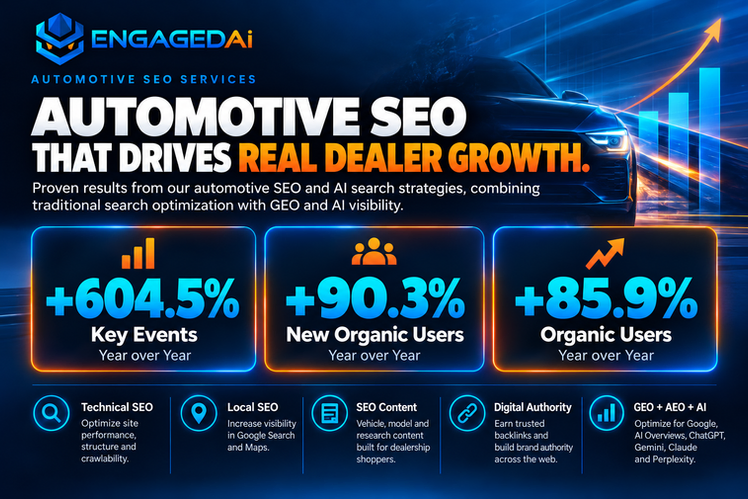
+604.5%
Key Events, Year over Year
+90.3%
New Organic Users, Year over Year
+85.9%
Organic Users, Year over Year
13,622
Google Business Profile Views (+32.7% YoY)
5,294
Business Profile Searches (+22.5% YoY)
565
Business Profile Calls (+21.2% YoY)
Reported results for one Chevrolet dealership’s combined search program, compared year over year against the prior-year period. These are not guaranteed or typical outcomes, and SEO alone did not cause every improvement.
GA4 key events are recorded analytics actions, not a count of unique leads, appointments, or sales. Review the event definitions and attribution before assigning business value to the increase.
Read the Full Automotive SEO & GEO Dealership Case StudyEach discipline has a distinct job. Together they help dealership information reach shoppers in Google Search, Google AI Overviews, ChatGPT, Gemini, Claude, and Perplexity.
Search engine optimization earns unpaid visibility in Google Search and Google Maps through technical access, useful content, local relevance, and authority.
Answer engine optimization makes dealership answers clear, specific, and easy to extract, so a direct question gets a direct, accurate response. Learn about automotive AEO
Generative engine optimization supports how credible dealership information may be used in generated responses from Google AI Overviews, ChatGPT, Gemini, Claude, and Perplexity. Learn about automotive GEO
AI visibility measurement tracks how often and how accurately a dealership appears in AI answers, alongside traditional rankings. Learn about AI visibility measurement
No provider can guarantee AI citations, recommendations, or rankings. A strong SEO foundation makes accurate dealership information easier for every system to find and understand.
We work only with dealerships, so inventory, manufacturer requirements, and sales and service departments are part of every plan.
Every report shows completed work, consistent comparison periods, and branded and nonbranded results separated where the data allows.
Priorities are set by customer demand and dealership goals, not by generic checklists or unlimited task lists.
Search, answer, and generative visibility are planned together so one effort supports the others.
We diagnose crawl, indexing, and site structure issues and coordinate fixes with your website provider.
Services typically cost 50% to 75% less than comparable market offerings because of lower sales and acquisition overhead.
Each page needs a clear purpose. A model page is the main research destination for a vehicle. A comparison helps customers evaluate alternatives. A blog answers a specific question. A nearby-market page explains why customers in that community might consider the dealership.
We review existing content before creating more. Worthwhile pages can be improved instead of replaced. New content should fill a genuine gap and connect readers with relevant inventory, research, or service information.
A dealership can have hundreds of indexed pages and still miss important searches in its own market.
More content isn’t automatically the answer. Sometimes the bigger opportunity is improving a model page that already ranks, correcting inventory pages that Google struggles to crawl, or removing outdated content that no longer helps shoppers.
At ENGAGEDAI, our approach starts with understanding what each page is supposed to accomplish. A homepage introduces the dealership. New and used vehicle inventory pages help customers shop available vehicles. Model research pages answer buying questions. Service pages should connect drivers with the maintenance and repair information they actually need.
Those pages shouldn’t all be competing for the same search terms.
Consider a dealership with 20 articles covering essentially the same SUV. Some may discuss specifications, others might include local city names, but the information and purpose are nearly identical.
Rather than publish article number 21, we evaluate whether the strongest existing page can become a more complete resource.
That may mean verifying current model information, incorporating useful trim comparisons, answering actual ownership questions, or connecting readers with relevant dealership inventory.
Pages that serve a distinct purpose can remain. Pages that duplicate stronger resources may be consolidated. When an old URL has a closely relevant replacement, a permanent redirect can preserve a useful path for visitors.
Removing low-value content is not automatically a ranking improvement. Every URL deserves an individual decision based on its quality, usefulness, search performance, and available replacement.
A generic vehicle article can tell you the seating capacity of a three-row SUV. A more useful dealership resource can help a shopper understand which available configurations meet their needs, how those vehicles compare, and what to verify before scheduling a test drive.
The same principle applies to service.
A page titled “Brake Service Near Me” offers little value when it simply repeats that brakes are important. A stronger service page explains the dealership’s actual services, which vehicles it supports, when an inspection may be appropriate, and how to schedule one.
Real service pricing, current offers, verified product specifications, department information, and accurate inventory details can make dealership content more useful—provided those details are maintained.
The goal isn’t to create the longest page. It’s to make the page worth visiting.
Automotive SEO Guide 2026: How Car Dealerships Win Google and AI Search
ENGAGEDAI’s automotive SEO services typically cost 50% to 75% less than comparable market offerings.
We do not pay sales commissions. We do not maintain a paid sales team. We do not spend on paid marketing to acquire customers. We earn our business organically and pass the savings directly to our customers.
Our lower overhead allows dealerships to put more of their investment toward the actual work: research, content, technical improvements, local visibility, and reporting.
Savings vary by provider, service scope, and dealership needs. Compare equivalent services and deliverables.
“ENGAGEDAI has been a great SEO partner for our team…”
All Star Autoplex Chevrolet & GMC
Excerpt
“Their team understands the unique needs of automotive dealerships…”
All Star Ford Kilgore
Excerpt
Your report should explain what changed, what was completed, and what the dealership should do next.
We evaluate relevant rankings, organic visitors, search queries, landing pages, Internet leads, tracked calls, and applicable service conversions, separating branded and nonbranded searches where the data allows.
Not every analytics event is a qualified lead. Not every inquiry becomes a sale. We use clear definitions and consistent comparison periods.
Reporting is organized around:
For a practical measurement framework, read our 2027 automotive SEO reporting guide, covering dealership KPIs, qualified leads, local search, AI visibility, and accountable ROI.
Prioritize manufacturer requirements, accurate vehicle information, model comparisons, local competition, relevant inventory, and service demand.
Prioritize actual inventory categories, buying questions, inspection information, vehicle history, local relevance, and accurate explanations of financing and coverage.
Use consistent technical and reporting standards while preserving each rooftop’s location, inventory, services, and market identity.
Bryan Wilson is Chief Search Officer at ENGAGEDAI, where he leads automotive search strategy across SEO, GEO, AEO and AI Visibility. Working in automotive search since 2010, Bryan focuses on how dealerships are discovered across Google, Maps, ChatGPT, Gemini, Claude, Perplexity and emerging AI search experiences. His work centers on combining technical search strategy, local visibility, original automotive content and AI visibility measurement to help dealerships understand not only where they rank, but whether they are becoming part of the answer.
Use these questions to compare any provider, including us.
Confirm the dealership keeps its pages, copy and images if the relationship ends.
Ask for completed work, comparison periods, and separate branded and nonbranded results.
Analytics events, clicks and qualified inquiries are different. Ask how each is counted.
Ask who requests technical changes, how they are tracked, and what happens when a platform limits a fix.
Ask how model pages, blogs and city pages are assigned distinct purposes.
Ask how attribution is handled so paid campaigns do not inflate organic results.
Automotive SEO improves a dealership’s website, local information, and content so vehicle shoppers and service customers can find it through unpaid search. It addresses inventory, research content, local competition, technical access, and measurable inquiries.
It connects shoppers who are researching models, comparing dealers, or looking for service with the dealership pages that answer those needs, producing organic visits, calls, and inquiries without paying for each click.
Timing depends on the website’s condition, competition, access, and search engine processing. Technical fixes can show effects within weeks, while content and authority usually build over several months. Establish a baseline and review progress over time rather than rely on a guaranteed deadline.
SEO earns visibility in traditional search results and maps. GEO focuses on how credible dealership information may be used in AI generated answers. Both depend on accurate, crawlable, useful content.
Answer engine optimization structures dealership content so common shopper questions get clear, direct, accurate answers that search engines and AI assistants can understand.
It can improve local relevance through accurate Google Business Profile information, useful local content, and trusted local mentions. Distance from the searcher still affects Google Maps results, so no provider can guarantee local pack positions.
Yes. Accurate categories, hours, departments, and contact details are part of local dealership SEO, and we track profile views, searches, and calls.
Not automatically. Start by determining whether each article has a useful purpose, relevant traffic, backlinks, or information customers still need. Some articles deserve an update. Others may be combined with stronger pages. Content that is obsolete and has no suitable replacement may warrant removal. A 301 redirect is appropriate when the destination genuinely satisfies the original page’s purpose—not simply because the dealership wants fewer indexed URLs.
They serve different search intentions. A model page should be the dealership’s primary resource for a specific vehicle and relevant buying information. A blog is more appropriate for a narrower question, comparison, or timely subject that doesn’t belong on the main model page. Both can be valuable when they contain distinct, accurate information and link naturally to relevant inventory.
Volume alone doesn’t improve search visibility. Google evaluates the value and reliability of content, regardless of whether AI assisted in creating it. Repetitive articles, inaccurate vehicle specifications, and pages created mainly to target keyword variations can create quality problems. AI can help with research and drafting, but dealership-specific facts, editorial review, and an identifiable purpose are what make the finished page useful.
Start with clear, publicly accessible information about the dealership, its location, inventory, services, and relevant areas of expertise. Maintain accurate structured data where appropriate, improve original explanations and factual evidence, and establish consistent business information across reliable sources. Being technically accessible and providing strong content can support AI discovery, but no optimization guarantees inclusion or a citation.
The first phase should establish a baseline for organic traffic, nonbranded searches, valuable landing pages, conversions, and Google Business Profile performance. It should also identify indexing problems, duplicated pages, technical limitations, and gaps in important dealership content.
The next priorities depend on the audit. They may include improving existing core pages, correcting canonical and redirect issues, updating model research, strengthening service information, or coordinating changes with the website vendor.
Progress should be measured by completed improvements and meaningful search and customer outcomes—not simply how many articles were published.
Through relevant rankings, organic visitors, search queries, landing pages, Internet leads, tracked calls, and Google Business Profile activity, using consistent definitions and comparison periods.
Automotive specialization, integrated SEO, AEO, and GEO work, transparent reporting, published dealer results, and pricing that typically runs 50% to 75% below comparable offerings.
Pricing depends on the dealership’s needs, service scope, and number of locations. Our services typically cost 50% to 75% less than comparable market offerings because we avoid sales commissions, a paid sales team, and paid customer acquisition marketing.
No provider controls Google’s results. We focus on technical access, useful content, local relevance, and documented progress toward valuable customer opportunities.
A full guide to inventory, local, technical and AI search optimization, with measurement advice for dealers.
ReadYear over year organic user and Google Business Profile results from a working dealership engagement.
ReadExplains the search changes dealers should plan for, separate from choosing a provider.
ReadShows how one shopper question becomes several searches, and which dealership pages should answer them.
ReadCovers how to measure dealership presence in AI answers alongside traditional rankings.
ReadYour dealership needs useful content, a sound technical foundation, clear local information, and a strategy informed by customer demand. ENGAGEDAI combines those priorities with lower sales and acquisition overhead and transparent reporting.